Talking To The Catt

This tool was developed by our own team. It was initially thought of by Shane as way of managing his own emotions and was later refined and named by Emma.
Talking To The CATT – Change Acceptance Tolerance Technique
Is this emotion serving me in any form of positive manner?
If no then:
Is there an actionable task or behavior that I can use to change the situation that is causing this emotion?
If no then:
Is there a way I can find to accept the situation as it is and to let go of what is upsetting me?
If no then:
How can I tolerate it, as there is nothing else in my ability to control at this moment
It often helps if you try this and get stuck to run through the exercise again with another person. Some things that we have found helpful when we get to how to tolerate are listed below such as :
List three events or things that happened to you today that were positive
Count all of the people that love you
Call a friend, coach or counsellor
Pick a colour and count all of the things you can see that are that colour
Find a happy thought or memory . clasp your hands and hold it as tight as you can for 5 seconds and then slowly exhale as you release the thought from your hands
Knead your feet (try to pick up your shoe with the ball of your feet. For context, think of when a cat kneads a blanket)
Calm visualization of a moment or place, take particular care in describing every possible detail about the mental image created. Ex. What time of day? What colour is the ground? Is the sun shining or behind a cloud etc.
Lifestyle Wheel
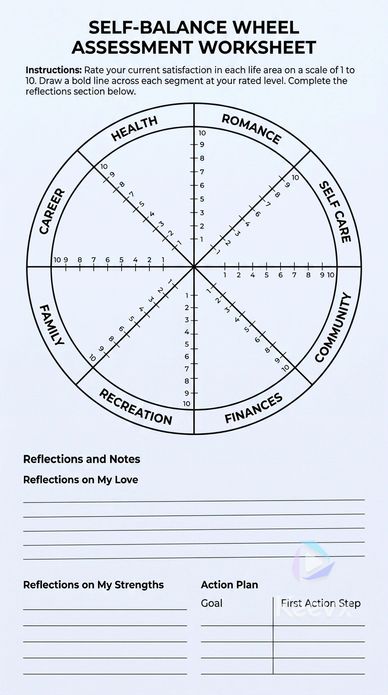
This tool is great for determining and measuring where we are at with our major life events. Place a dot on each category from 1-10. This tool is adapted from the SMART Recovery handbook, the purpose is to find out how much time you are spending on any major life area. The concept is that as a wheel you want it to be able to roll so if there is a life area that you are over or under-devoting time to you can re-asses and spread resources accordingly. The Goal is not to be ten out of ten in each area but top have a healthy balance in each so that you wheel will roll.
Cost Benefit Anlaysis
Self Check In Checklist

This tool is used when trying to make a decision. It allows us to see the benefits and costs to our use or other behaviors that may be detrimental. Once we way the costs and benefits it allows us to see if our decisions align with our values, as well as comparing long term benefits versus short term benefits. We have found it to be a very helpful tool and the format has been taken from SMART Recovery book
Self Check In Checklist
Self Check In Checklist
Self Check In Checklist
The self check in checklist is nothing more than a series of questions to ask yourself a couple times a day. Shane has designed a checklist that works for him but edit it below as needed:
How am I feeling ? - (use feelings wheel if needed)
What is my body temperature?
How is my stomach feeling?
Am I withdrawing or isolating myself from others?
Am I procrastinating on something?
Am I indulging in grandiose behavior?
Is my jaw clenching?
Am I hurrying through tasks without justifiable reason?
When and what was the last thing I ate?
What have my spending habits been like?
Where am I in my window of tolerance?
Am I engaging frequently in negative self talk?
When was the last time I talked about my feelings?
How much sleep have I been getting? Am I tired?
When was the last time I exercised?
When and what was my last self care activity?
Feelings Wheel
Self Check In Checklist
Counting Colours
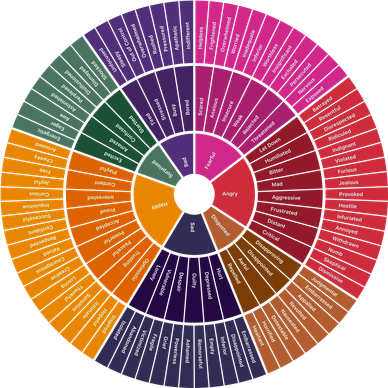
Sometimes we need to name it to tame it. Using a feelings wheel can prompt us to examine what we are feeling both on a surface and deeper level. Often what we are feeling is not limited to just one feeling and we are feeling a complex mix of multiple specific feelings. A feelings wheel can be a great tool used alone or partnered with another tool like the Self Check In Checklist. If you cannot read the image we encourage to find a feelings wheel on google or anywhere that is convenient for you!
Counting Colours
Self Check In Checklist
Counting Colours
Counting Colours is another adaption of other tools developed by Shane. It is simply picking a colour at random and counting how many things and shades of that colour you can see around you. The more specific that you can be the more this grounding exercise will be helpful. This is a great urge coping tool for when you are stuck in a repetitive loop.
5-4-3-2-1 or 3-2-1
Qi Gong Breathing Exercise and Accupressure
Qi Gong Breathing Exercise and Accupressure
Both of these tools focus on paying particular attention to the sensory input around us to ground us in the present moment and can be an excellent skill in coping with urges. The basic premise is to name 5 things you can see, 4 things that you can hear, 3 things that you can touch, 2 things that you can smell and 1 thing that you can touch. Once again the more detailed you can be in acknowledging each o these things the more effective it will be.3-2-1 is the same premise but simplified, in 3 things you can see, 2 things you can hear and one thing that you can touch. Try both and see which works better for you at this time!
Qi Gong Breathing Exercise and Accupressure
Qi Gong Breathing Exercise and Accupressure
Qi Gong Breathing Exercise and Accupressure
Breathing exercises can be incredibly helpful when we are feeling disregulated. As we have found that many people struggle with box breathing we recommend finding a private space and try this breathing exercise that comes from Qi-Gong, a 5000 year old for of moving meditation, proceeded by a 2-5 minute accupressure session.
To start on the accupressure follow the bone of your index finger up into the tissue between your thumb and forefinger, somewhere along the bone just into the web of your hand you will find a point that gives you a small jolt when you press on it. Put pressure on this point for 1-3 minutes and then repeat on the opposite hand.
The breathing exercise depends on preference but one we find particularly effective is to breathe in while scooping the air in front of you, pushing your hands together in front of you as you hold the breath and the pushing you hands out in front of you as you exhale.
Urge Log
Qi Gong Breathing Exercise and Accupressure
The Anger Iceberg
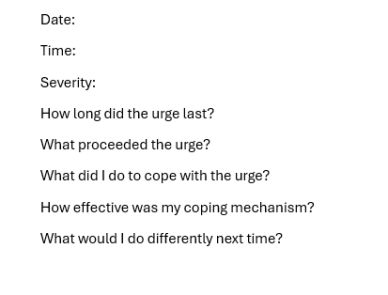
An urge log can be a great tool. It helps us to identify major stressors and barriers that we encounter as we go through our recovery. We recommend keeping yours on your phone so that it is accessible 24 hours a day. When urges arise we log the important information such as date, time, how long the urge lasted, how strong the urge was, what happened proceeding the urge, what we did to deal with it and how effective our coping tools were. By doing this when we review the log we can identify what happened, what we did well and what we should do next time.
The Anger Iceberg
Personify And Disarm
The Anger Iceberg
Anger is often a surface level emotion. When we examine what is beneath the anger it can often help us to regulate this big feeling. To examine your anger quickly draw an iceberg (most of what is there is below the surface) and draw the water line. Then with the help of a feelings wheel write in the emotions that are causing the anger. This often includes of fear, self doubt etc. Once you have properly identified and named what is going on below the surface, we can make a plan to address both the feeling and the cause.
Personify And Disarm
Personify And Disarm
Personify And Disarm
Personify And Disarm (formerly known as DISARM) is a SMART Recovery tool that helps you manage urges by treating them as an external, opposing force rather than part of yourself. By giving urges a name—like "the monster" or "the salesman"—and challenging their, you create distance, reducing their power and controlling your reactions.
- Personify the Urge: Give your urge a name that highlights its manipulative nature, such as "The Weasel," "The Brat," "The Voice," or "The Enemy".
- Identify the Tactics: Recognize how this persona tries to convince you to engage in old behaviors (e.g., "Just one won't hurt," "You've had a hard day").
- Disarm with Counter-Statements: Actively talk back to this persona with firm statements like, "Nice try," "I am in control," or "You can't fool me".
- Refocus Your Attention: Immediately switch your focus to activities or thoughts that align with your long-term recovery goals. [
Key Aspects of the Tool
- Externalization: It helps you see that you are not your urges—they are temporary reactions or impulses.
- Reduces Guilt: By separating your true self from the addictive voice, you can address cravings with less shame and more, as explained in the SMART Recovery tool sheet.
- Empowerment: This approach transforms you from a victim of a craving into someone actively defending their recovery.
DENTS
Personify And Disarm
Personify And Disarm
DENTS is a term borrowed from SMART Recovery and is also excellent ion helping to cope with urges, particularly when the arise seemingly from nowhere. that stands for
- D - Deny or Delay: Remind yourself that the urge is temporary and will pass, often within 10–20 minutes. Delay giving in, one moment at a time.
- E - Escape: Remove yourself from the situation, place, or conversation triggering the urge.
- N - Neutralize: Acknowledge the urge without judgment and let it fade like a wave, rather than fighting it directly.
- T - Tasks (Engage in Tasks): Distract yourself with other activities, such as cleaning, calling a friend, or working on a hobby.
- S - Swap (Change Self-Talk): Replace negative or urge-driven thoughts with positive ones, such as "This urge will pass" or "I can handle this